The Illusion of the Binary
Conventional discussions about wealth often operate on a simple binary: you are either financially free or you are not. This black-and-white perspective, however, fails to capture the complex texture of economic life. In reality, agency is rarely absolute. It is constrained by the scale of daily choices, the weight of immediate needs, and the psychological burden of limited resources. A more nuanced way to understand this dynamic is through a six-tiered framework that categorizes financial autonomy based on the monetary value of individual decisions. By shifting the metric from total net worth to the “decision value,” this model offers a graduated spectrum of economic agency. It posits that as the dollar amount associated with a single decision increases, an individual’s capacity for choice expands, thereby reducing the psychological and practical constraints imposed by limited resources.
Defining the Spectrum of Choice
The core thesis of this framework is that financial freedom is not a static destination but a dynamic, logarithmic progression of decision-making power. The primary driver of financial stress is not merely the lack of wealth, but the low value of individual decisions. At the lowest tiers, where decisions are trivial in monetary terms but critical for survival, individuals experience a state of constant economic vulnerability. As one ascends the hierarchy, the nature of freedom shifts qualitatively from mere subsistence to lifestyle enhancement, and ultimately to altruistic capacity. This model challenges the notion that financial security is achieved at a single point, suggesting instead that each tier represents a distinct psychological and practical reality.
The Six Levels of Autonomy
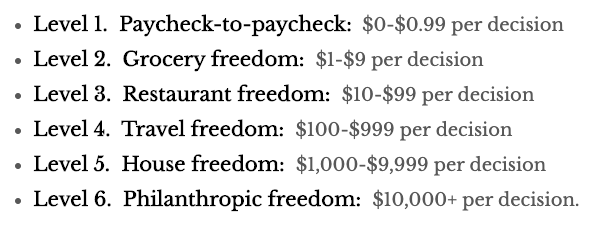
The framework defines six distinct levels, each representing a specific threshold of economic agency. These levels are characterized by the following monetary ranges per decision:
- Level 1 ($0–$0.99): Paycheck-to-Paycheck. This tier is defined by decisions that are trivial in monetary terms but critical for survival. The “paycheck-to-paycheck” dynamic creates a state of constant economic vulnerability, where the margin for error is nonexistent.
- Level 2 ($1–$9): Grocery Freedom. This level allows for basic sustenance without immediate crisis. It represents the ability to secure food and essential goods without the acute anxiety associated with Level 1.
- Level 3 ($10–$99): Restaurant Freedom. This tier enables dining out without significant anxiety. It marks the transition from survival to basic leisure, allowing for social and recreational spending that does not jeopardize essential needs.
- Level 4 ($100–$999): Travel Freedom. Defined by the capacity for leisure travel, this level represents a significant expansion of life experiences. It allows for decisions that enhance quality of life through mobility and exploration.
- Level 5 ($1,000–$9,999): House Freedom. Associated with major asset purchases like home ownership, this tier represents the ability to make high-stakes financial commitments. It is a marker of substantial economic stability and long-term planning capability.
- Level 6 ($10,000+): Philanthropic Freedom. This final tier represents the capacity for large-scale altruism. It is characterized by the ability to make decisions that benefit others without impacting the individual’s own financial security.
The Logarithmic Nature of Progress
A key insight from this model is the direct correlation between financial stress and the low value of individual decisions. The notes highlight a logarithmic-like scaling of these thresholds. The jump from Level 1 to Level 2 is relatively small, whereas the transition from Level 5 to Level 6 represents a significant order-of-magnitude increase. This implies that achieving true “philanthropic freedom” requires a fundamentally different scale of wealth compared to achieving “house freedom.” The model suggests that the psychological relief gained from moving from Level 4 to Level 5 is not linearly proportional to the financial resources required to move from Level 5 to Level 6. This non-linear progression underscores the idea that the highest forms of financial agency are not just extensions of previous levels, but entirely different categories of economic existence.
Practical Applications for Goal Setting
The framework provides a practical tool for individuals to diagnose their current financial position and set targeted goals. By linking abstract wealth goals to specific life experiences, the model makes financial progress more tangible. For instance, an individual stuck at Level 2 (“Grocery Freedom”) might focus on increasing income or reducing fixed costs to reach the $10 threshold for Level 3 (“Restaurant Freedom”). This specific goal allows the individual to gain the ability to choose dining out without immediate financial anxiety, providing a clear, measurable milestone. Financial advisors can also utilize these tiers to help clients visualize progress. Instead of discussing vague concepts like “net worth” or “annual income,” advisors can frame goals in terms of decision-making power. A client aiming for “Travel Freedom” (Level 4) can be guided to understand the specific financial behaviors required to reach the $100–$999 decision range. This approach can enhance client engagement by connecting financial planning to tangible lifestyle improvements.
Critical Limitations and Context
While the framework offers a compelling narrative for understanding financial autonomy, it is important to recognize its limitations. The model is highly subjective and lacks context regarding cost of living, inflation, or geographic location. A $100 decision in a rural area may carry different weight than in a major metropolitan city, yet the framework treats these values as universal constants. This lack of geographic and temporal context limits the model’s applicability across diverse economic environments. Furthermore, the text does not clearly define what constitutes a “decision.” It is ambiguous whether buying a $500 item is one decision or multiple smaller ones. This definitional vagueness can lead to inconsistent application of the framework. Additionally, the model ignores non-monetary factors such as debt, health, or time, which significantly impact perceived freedom. An individual with high decision value but significant debt or health issues may not experience the same level of autonomy as the model suggests. The author presents these claims as a descriptive framework rather than an empirically validated economic theory. This distinction is crucial, as the model lacks the rigorous testing required to establish it as a universal law of financial behavior. The logarithmic scaling of thresholds is presented as an observation rather than a proven mathematical relationship, leaving room for debate regarding the precise nature of the progression.
Verifying the Model
Several claims within the framework require further empirical verification to establish their validity and generalizability. The assertion that the progression of financial autonomy follows a logarithmic-like scaling needs to be tested against large-scale financial data to see if this scaling is consistent across different demographics and economic contexts. The model posits a direct correlation between financial stress and the low value of individual decisions. While intuitive, this relationship needs to be quantified through psychological and financial studies to determine the strength and nature of this correlation. The framework assumes that the defined monetary ranges are universally applicable. Verification is needed to determine how these tiers adjust for cost of living, inflation, and geographic location. Are the thresholds for “Restaurant Freedom” or “Travel Freedom” consistent across different regions and countries? The model’s reliance on the concept of a “decision” requires a clear, operational definition. How do individuals perceive and categorize their financial decisions? Does the framework’s definition align with actual consumer behavior and psychological perception? Finally, the model’s exclusion of non-monetary factors such as debt, health, and time is a significant limitation. Research is needed to determine how these factors interact with monetary decision value to influence perceived financial autonomy.