
The Economics of Immediate Need
In the competitive landscape of digital marketing, the legal sector operates under a unique economic logic. Visibility is not just a metric; it is a financial asset that commands extraordinary premiums. A data-driven analysis, originally compiled by Bain & Company, examines the most expensive search keywords for U.S. law firms to uncover the mechanics behind these high costs. The core finding is that practice areas involving immediate physical harm, specifically personal injury and accident-related services, drive the highest cost-per-click (CPC) rates in the industry.
This phenomenon is not merely a reflection of aggressive bidding strategies. It is fundamentally justified by the economic structure of the legal profession itself. The high lifetime value of a single client in these fields allows firms to sustain significant customer acquisition costs. When a user searches for legal help after a car accident, the potential revenue from that single case is substantial. This high value supports a high entry price for the digital visibility that leads to that client.
Specificity Drives Cost
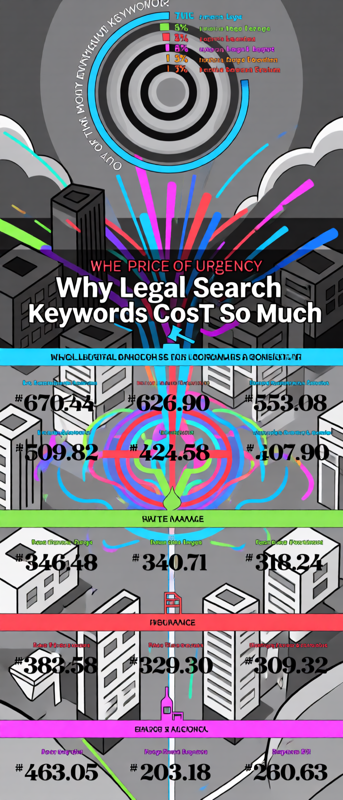
The data reveals a clear pattern: specificity drives cost. Rather than generic terms like “lawyer,” the most expensive queries are hyper-local and intent-heavy. For example, a search for “Accident attorney Riverdale VA” carries a CPC of $626.90, while “Personal Injury attorney Colorado” is valued at $553.08. These figures illustrate that digital visibility in the legal sector is less about broad brand awareness and more about capturing users at the precise moment of crisis.
The most expensive keyword recorded in the dataset is listed as “Antonlo carweck attomey,” with a CPC of $670.44. It is critical to note that this entry likely contains significant typographical or Optical Character Recognition (OCR) errors, potentially referring to “Atlanta car wreck attorney.” Despite the garbled text, the underlying intent is clear: a user searching for a car accident attorney in a major metropolitan area. This aligns with the broader trend of high-value, high-intent queries where the user’s need is immediate and specific.
The Role of Location
A pivotal statistic in the analysis is that 58% of these high-value keywords are location-sensitive. This suggests that generic national searches are less valuable to advertisers than local, immediate needs. When a user searches for a lawyer in a specific city or town, they are signaling a higher probability of conversion. This justifies the higher bid from law firms, as the user is likely ready to hire the first credible firm they contact.
Consider the keyword “Accident attorney Gary IN,” which has a CPC of $507.54. This represents a user who has likely just been involved in a collision in Gary, Indiana, and is actively seeking representation. The cost reflects the urgency and the high probability that this user will hire a local firm. In contrast, a generic search for “lawyer” would likely have a significantly lower CPC because the user’s intent is less defined and the conversion path is longer.
Adjacent Niches and Premium Pricing
While personal injury dominates the highest price points, other specialized niches also command premium pricing. Keywords related to “Water Damage” show CPCs ranging from $309.32 to $346.49, while “Drugs & Alcohol” related legal searches range from $286.63 to $463.05. This illustrates that while auto accidents are the most lucrative, other areas involving immediate property or personal liability also attract significant advertising competition.
The inclusion of “Auto rehab” at $463.05 is also notable. While not a direct legal service, it is closely associated with the post-accident ecosystem. This suggests that law firms or related service providers are bidding on adjacent terms to capture users in the recovery phase, further extending the funnel for potential legal clients. This strategy allows firms to engage with users who are in the process of dealing with the aftermath of an accident, a period when legal needs are often realized.
Strategic Implications for Law Firms
Law firms and their marketing teams can leverage this data to optimize digital advertising budgets. First, firms specializing in personal injury or auto accidents must anticipate higher customer acquisition costs. They should adjust their client lifetime value (CLV) calculations to ensure that the revenue from a single case covers the high CPC and associated overhead. If a firm’s average case value does not support a $500+ acquisition cost, they may need to refine their targeting or consider alternative channels.
Marketing teams should prioritize bidding on geographically relevant terms that align with their specific service areas. By focusing on hyper-local keywords, firms can target users with higher intent, potentially improving conversion rates even if the CPC is high. This approach allows firms to compete more effectively against larger national firms that may be bidding on broader, less efficient terms. Additionally, firms can use the data to identify emerging high-value niches. The presence of “Water Damage” and “Drugs & Alcohol” keywords in the high-CPC range suggests that firms with expertise in these areas can capitalize on premium pricing by allocating resources to the most profitable digital channels.
Limitations and Data Integrity
It is crucial to approach this data with caution due to several significant limitations. First, the source material contains substantial Optical Character Recognition (OCR) errors, which introduce uncertainty regarding the exact phrasing of keywords and the precision of associated costs. Examples include the garbled text “Antonlo” and “Cdorado,” as well as unclear numerical entries. These errors make it difficult to verify the exact keywords and their corresponding CPCs, limiting the reliability of the specific figures.
Second, the data appears to be a snapshot from a specific time period. CPCs are dynamic and fluctuate based on market competition, seasonality, and economic conditions. Therefore, these figures may not reflect current market conditions. A CPC of $670.44 recorded in the past may be significantly higher or lower today, depending on the competitive landscape. Finally, while the data is attributed to Bain & Company, the specific methodology used to calculate these averages is not detailed in the excerpt. This lack of methodological transparency limits the ability to fully assess the reliability or generalizability of the findings. Consequently, while the trends suggest a strong correlation between location specificity and high CPCs in the legal sector, the specific values should be treated as indicative rather than definitive benchmarks for current budgeting.